How to Create a School Schedule: Complete Guide for Students
By Harsh Sahani•Published: 2026-09-24•9 min read
TL;DR
A school day feels less stressful with a clear plan. This guide shows how to create a school schedule, starting with fixed commitments like classes, meals, and travel, then adding homework, study blocks, and breaks. It explains how to give extra time to difficult subjects, protect sleep, and still leave room for hobbies and family time. Common mistakes, like overloading the day or skipping breaks, are covered too. Use these steps to build a school timetable that feels calm, realistic, and easy to follow every week.
A good school day can quickly become stressful when classes, homework, exams, activities, hobbies, and personal time all need attention. The problem is often not a lack of time but a lack of a clear plan.
Learning how to create a school schedule can make daily life easier and more organized. A well-planned School Schedule helps students understand what needs to be done, when to do it, and how much time to spend on each task. It can also help prevent the habit of leaving everything until the last minute.
A useful schedule should not fill every minute of the day. Instead, it should create a practical routine that allows enough time for studying, rest, meals, hobbies, family time, and sleep. This complete guide explains how to create a student timetable that works well and how to keep it useful throughout the year.
What Is a School Schedule?
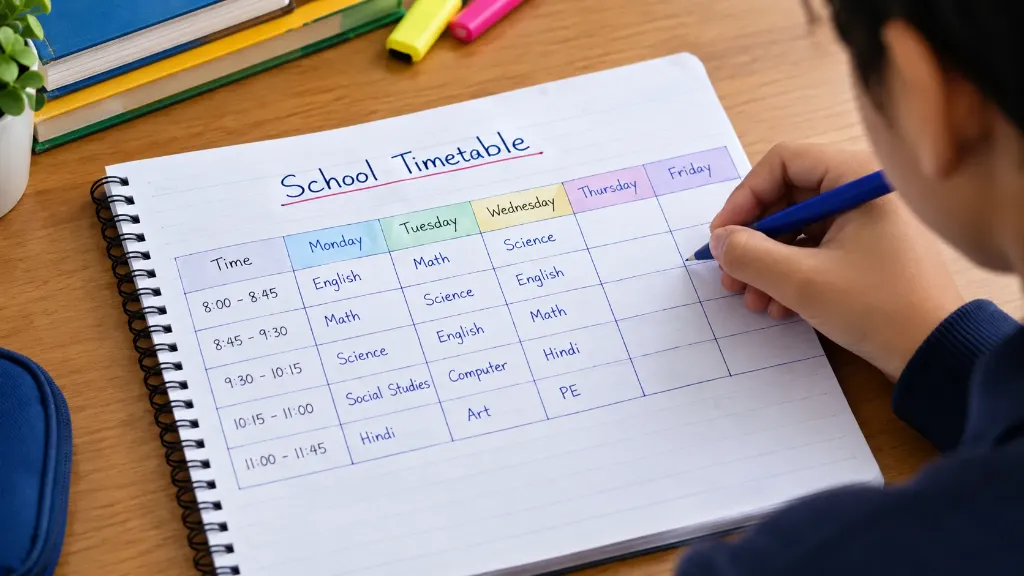
A school schedule is a simple plan that organizes a student's classes, study sessions, homework, activities, breaks, and other important tasks during the day or week. It can be created as a daily plan, weekly school timetable, monthly calendar, or a combination of all three. The best format depends on the student's age, school routine, subjects, activities, and personal preferences. A strong schedule answers a few basic questions:- What classes or tasks are planned today?
- When should homework be completed?
- Which subjects need extra study time?
- When are tests, projects, and deadlines coming?
- When is there time for meals, exercise, hobbies, and rest?
- What time should the day end so enough sleep is possible?
Why Do Students Need a School Schedule?
Without a clear plan, small tasks can pile up quickly. A student may remember an assignment only after dinner, forget about an upcoming test, or spend too much time on one subject while another receives almost no attention. A well-designed student timetable can help with:- Better time management: Each important task receives a specific place in the day.
- Less last-minute work: Assignments and exam preparation can be divided into smaller sessions.
- Better balance: Study time can exist alongside hobbies, exercise, family activities, and relaxation.
- Clear priorities: Important deadlines become easier to see.
- More consistency: Studying at regular times can become a habit instead of something that happens only when motivation appears.
How to Create a School Schedule Step by Step
Creating a useful schedule is easier when the process starts with the fixed parts of the day.1. Write Down Your Fixed Commitments
Start by listing everything that already has a set time. This can include:- School hours
- Travel time
- Lunch and dinner
- Sports practice
- Tuition or coaching
- Music or art classes
- Family commitments
- Regular appointments
- Bedtime and wake-up time
2. Add Every Subject and Assignment
Next, list the subjects that need attention. Look at homework, upcoming tests, projects, presentations, reading tasks, and other deadlines. Mark tasks that need immediate attention and those that can be handled later. A useful trick is to break large projects into smaller tasks. Instead of writing "complete science project," use steps such as research, notes, first draft, revision, and final submission. This makes the workload feel more manageable and gives the schedule clear actions.3. Give More Time to Difficult Subjects
Not every subject needs the same amount of study time. A subject that feels difficult may need several shorter sessions during the week. Easier subjects may need less frequent review. Avoid creating a schedule that gives exactly one hour to every subject simply because the numbers look neat. The goal is to use time intelligently. For example, a student may schedule mathematics practice on Monday, Wednesday, and Friday, while using Tuesday and Thursday for reading and science review.4. Use Shorter Study Blocks
Long study sessions can become tiring, especially after a full school day. Instead of planning several hours of nonstop studying, divide the workload into focused blocks with short breaks. For example:- 4:00 to 4:30 PM: Mathematics
- 4:30 to 4:40 PM: Break
- 4:40 to 5:10 PM: Science
- 5:10 to 5:25 PM: Break
- 5:25 to 5:55 PM: English
5. Schedule Breaks Properly
Breaks are not wasted time. After school, students often need time to eat, relax, move around, or simply reset before beginning another task. Without breaks, a schedule can become so demanding that it is abandoned after a few days. Keep breaks realistic. A short break can help refresh attention, while a long phone or gaming session can make it difficult to return to studying.6. Protect Sleep in Your Schedule
Sleep should be treated as a fixed part of a school schedule, not as leftover time. The American Academy of Sleep Medicine recommends 9 to 12 hours of sleep for children aged 6 to 12 and 8 to 10 hours for teenagers aged 13 to 18. Regularly getting less sleep can be associated with attention, behavior, and learning problems. That means staying awake late every night to finish homework is not a good long-term scheduling strategy. If the plan regularly pushes homework into very late hours, the schedule itself needs adjustment.7. Add Personal Time
A complete student timetable should not be only about school. Include time for:- Sports and exercise
- Hobbies
- Friends
- Family
- Reading for enjoyment
- Creative activities
- Relaxation
Create a Weekly School Timetable
A weekly view is useful because it shows the bigger picture. At the beginning of the week, check upcoming tests, assignments, projects, and activities. Then distribute study sessions across the available days. For example, if a history test is on Friday, do not wait until Thursday night. Schedule short review sessions earlier in the week. Spaced practice is specifically designed around distributing learning across multiple sessions instead of concentrating it into one last-minute study period. A weekly schedule also makes it easier to notice overloaded days. If three major assignments are due on the same day, starting one earlier can reduce pressure.Use an Online Schedule Maker
Creating a timetable manually can work, but an online tool can make the process faster and easier to adjust. An Online Schedule Maker can be useful when classes, study blocks, activities, and personal commitments need to fit into one clear plan. Students can use a digital schedule to organize their week and make changes when school routines change. For a simple way to build and organize a schedule, try Online Schedule Maker. The biggest benefit is not simply having a digital timetable. It is having a clear visual plan that can be checked quickly instead of trying to remember everything.Keep Some Flexible Time
One of the biggest mistakes in schedule planning is filling every available minute. Unexpected homework, family plans, school announcements, delayed travel, or extra revision can easily change a day. Leave some open space so one unexpected event does not destroy the entire plan. A flexible schedule is usually more practical than a perfect-looking schedule that has no room for change.Review Your Schedule Every Week
A School Schedule should not remain unchanged for the entire year. At the end of each week, spend a few minutes checking:- Which tasks were completed?
- Which tasks were repeatedly delayed?
- Which subjects need more time?
- Were breaks long enough?
- Was enough sleep protected?
- Did any activity make the schedule too crowded?
- Are upcoming deadlines clearly included?
Common School Schedule Mistakes to Avoid
Even a detailed timetable can fail when it is unrealistic. Avoid these common mistakes:- Planning too much: A schedule packed with tasks can become stressful.
- Ignoring travel time: Moving between school, home, coaching, and activities takes real time.
- Leaving no breaks: Continuous study can quickly become exhausting.
- Studying only before exams: Regular review is generally more useful than relying entirely on last-minute cramming.
- Sacrificing sleep: Late-night study should not become the normal solution to poor planning.
- Copying someone else's timetable: A schedule should match the student's actual classes, responsibilities, energy levels, and goals.
- Never updating the plan: School workloads change, so the timetable should change too.
Example of a Simple Student Timetable
A basic weekday schedule could look like this:- 6:30 AM: Wake up and get ready
- 7:30 AM: Travel to school
- 8:00 AM to 3:00 PM: School and classes
- 3:30 PM: Lunch and rest
- 4:00 PM: Homework
- 4:45 PM: Short break
- 5:00 PM: Focused study session
- 5:45 PM: Sports or personal activity
- 6:45 PM: Dinner and family time
- 7:30 PM: Revision or unfinished homework
- 8:30 PM: Prepare for the next school day
- 9:00 PM onward: Relax and prepare for sleep